
Source control
Identify and correct the leak, condensation, or other moisture condition. Remediation that ignores the source invites recurring damage.
Mold problems often start with persistent moisture—not simply a stain that needs cleaning.
The first question is not how to remove a visible stain—it is why the material stayed damp. Mold remediation addresses affected materials and conditions that permitted growth. If the moisture source remains, surface cleaning alone is unlikely to solve the underlying problem.
A musty odor can justify investigating concealed moisture, especially near past leaks, plumbing penetrations, air-conditioning condensate lines, crawl spaces, and wall cavities. Odor does not reveal the extent or type of microbial growth. Finding wet materials and documenting conditions is more useful than assuming a problem based on appearance or smell alone.
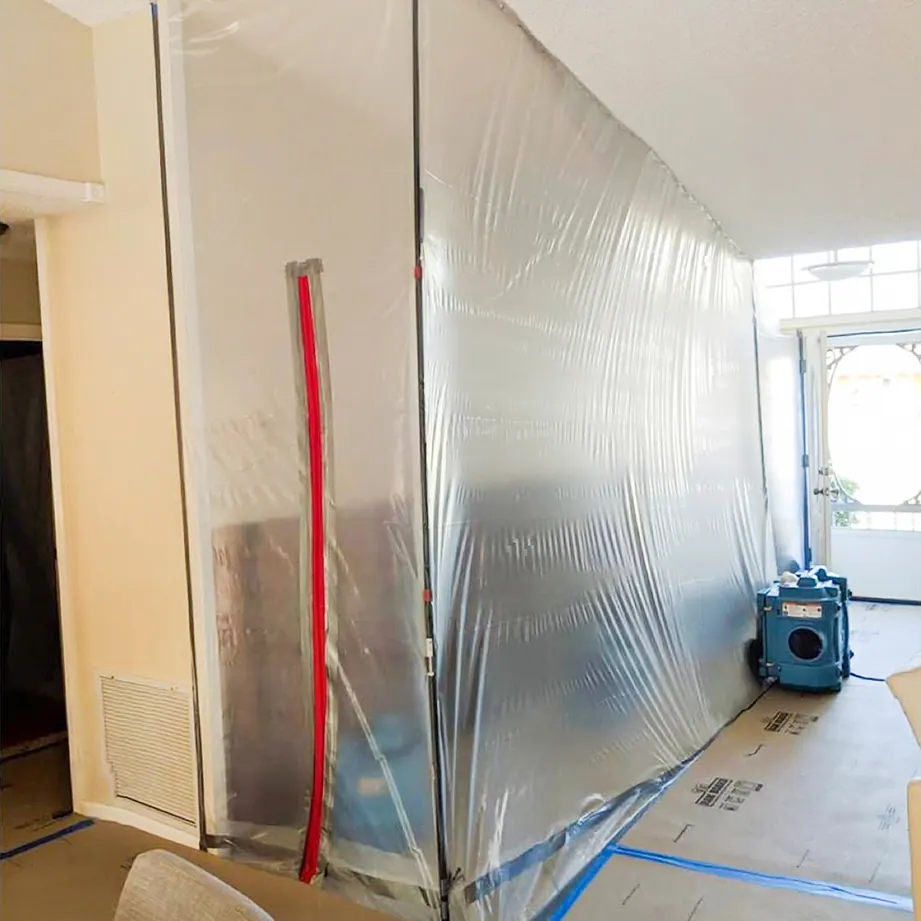
A remediation plan should reflect the affected materials, location, occupancy considerations, and extent of the problem. Work may involve isolating affected areas, using appropriate worker protections and engineering controls, removing unsalvageable porous materials, cleaning salvageable surfaces, and managing dust and debris. The appropriate sequence depends on an assessment—not a universal spray treatment.
Identify and correct the leak, condensation, or other moisture condition. Remediation that ignores the source invites recurring damage.
Drywall, wood, insulation, and other materials cannot all be handled identically. Porosity, deterioration, and contamination matter.
Work practices should limit the movement of affected dust and debris into cleaner areas, where appropriate for the job.
Completion is about addressing the identified problem and meeting applicable project criteria—not claiming that a building is permanently “mold-free.”
Painting or applying a coating over active growth does not substitute for identifying the source of moisture and addressing affected materials. Coatings have specific roles in some remediation projects, but they are not a shortcut around cleaning or removal decisions.
That depends on where the affected materials are located, the extent of disturbance, the people occupying the space, and the work plan. People with health vulnerabilities may need additional precautions. A qualified professional should assess the project-specific risks; we cannot make a blanket occupancy promise online.
Controlling moisture remains the priority. If building materials stayed wet after an appliance leak, burst pipe, or plumbing problem, investigation may need to address both water damage and possible microbial growth. Read our water damage restoration guide for how extraction and structural drying fit together.
Not necessarily. A lasting solution requires correcting the moisture problem and addressing affected materials. Painting or spraying a stain does not establish that the underlying issue is resolved.
Document the affected area, correct the leak, and have persistent dampness or suspected concealed growth evaluated. The appropriate scope depends on the extent and location of the condition.