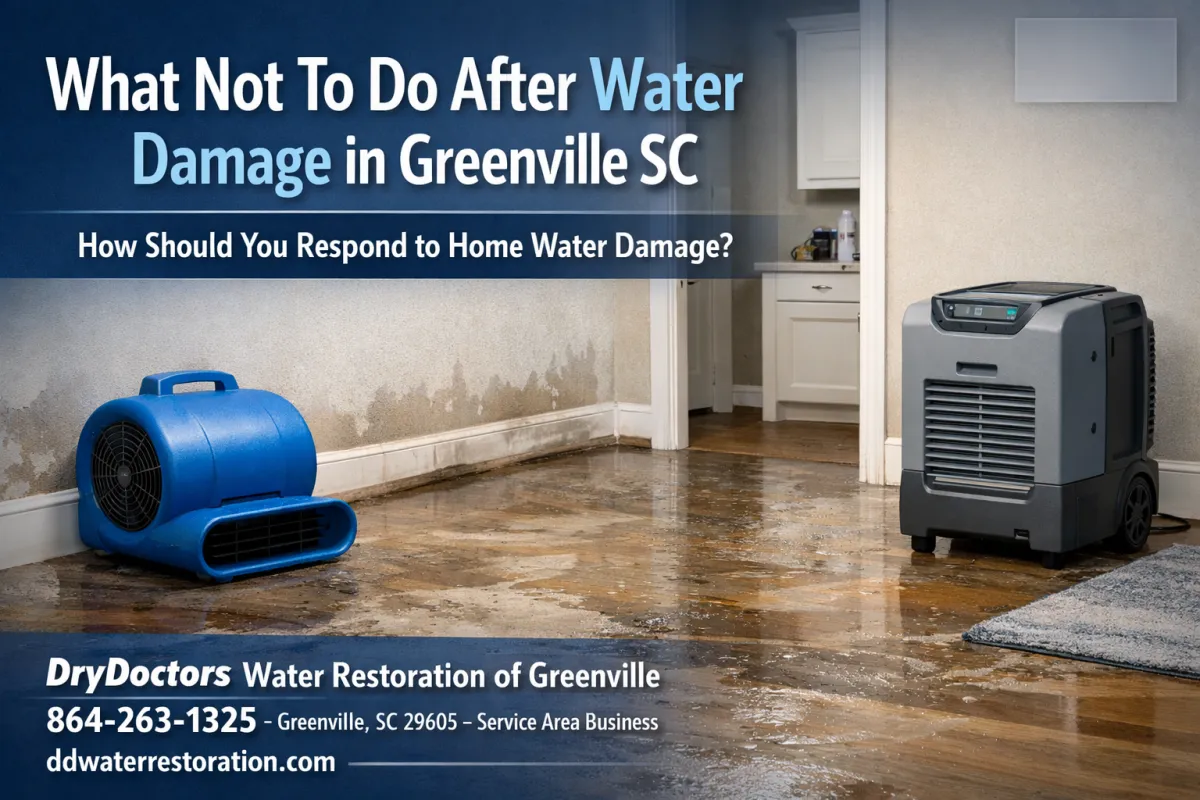
What Not To Do After Water Damage | Greenville SC Guide
After water damage in Greenville, SC, you should not delay drying, assume surfaces are safe, or attempt partial cleanup—because moisture spreads invisibly into materials and causes structural damage within hours.
What Not To Do After Water Damage (And Why It Matters)
When water damage hits a home or business in Greenville, the biggest mistakes usually come from underestimating how water behaves inside building materials. Water doesn’t stay where you see it—it migrates through drywall, flooring, insulation, and framing through capillary action and absorption.
That means what you don’t do immediately can determine whether the damage stays minor or turns into structural deterioration.
1. Do NOT Wait to Start Drying
Water begins penetrating materials immediately. Drywall, carpet padding, and insulation absorb moisture quickly, while subfloors and framing retain it for long periods.
Within hours: moisture spreads behind walls and under flooring
Within 24–48 hours: materials begin breaking down and odors develop
Beyond that: structural components may require removal
Delaying action allows moisture to move deeper into the structure, making drying significantly more difficult and invasive.
2. Do NOT Assume It’s “Just Surface Water”
Visible water is only part of the problem. The real issue is hidden moisture.
Water travels:
Behind baseboards
Under flooring systems
Into cabinet voids
Inside wall cavities
Surface drying (like towels or fans) only removes visible moisture. True drying requires controlled airflow, dehumidification, and moisture measurement to verify internal conditions.
3. Do NOT Turn On HVAC Without Inspection
Running your HVAC system after water damage can spread moisture and contaminants throughout the home.
Why this matters:
Duct systems can pull in humid air
Moisture can condense inside vents
Odors and particles can circulate into unaffected areas
Without proper containment and filtration, HVAC use can expand the damage zone instead of helping.
4. Do NOT Leave Wet Materials in Place
Certain materials absorb water rapidly and cannot dry effectively once saturated.
High-risk materials:
Carpet padding
Insulation
Particle board cabinetry
Laminate flooring
These materials trap moisture internally, preventing evaporation. Leaving them in place slows drying and can damage surrounding structural components.
5. Do NOT Ignore Flooring and Subfloor Moisture
Flooring is part of a layered system—not just a surface.
Water moves:
Through seams in hardwood or laminate
Into the subfloor below
Into framing beneath
Even if the top looks dry, the subfloor may still be holding moisture. This leads to:
Warping
Adhesive failure
Structural weakening
Proper drying requires addressing both the finish floor and the underlying system.
6. Do NOT Rely on Fans Alone
Air movement helps, but it does NOT equal drying.
Drying requires:
Airflow (to move moisture off surfaces)
Dehumidification (to remove moisture from the air)
Time and monitoring
Without dehumidifiers, moisture simply redistributes into the air and reabsorbs into materials.
7. Do NOT Skip Professional Moisture Detection
The most dangerous moisture is the moisture you cannot see.
Professional restoration uses:
Moisture meters
Thermal imaging
Material-specific drying strategies
Without detection, you’re guessing—and missed moisture is what leads to long-term damage.
What You Should Do Instead
If you’re dealing with water damage in Greenville, SC:
Act immediately to limit moisture migration
Focus on structural drying, not just cleanup
Verify moisture levels before assuming the space is dry
At DryDoctors Water Restoration of Greenville, we handle water damage based on how moisture actually behaves inside materials—not just what’s visible.
👉 Learn more about our water damage restoration services in Greenville
👉 See how we handle emergency water removal in Greenville
https://www.podbean.com/eas/pb-xtujq-1a8655b
Final Takeaway
Water damage is not just about water—it’s about how moisture moves, absorbs, and hides inside your structure. The biggest mistakes happen when people treat it like a surface problem instead of a structural one.
If you’re unsure what to do next, acting quickly and correctly is what prevents small damage from becoming major reconstruction.
Contact:
DryDoctors Water Restoration of Greenville
📍 Greenville, SC
📞 864-263-1325
📍 https://ddwaterrestoration.com/